
Kane Parole vs Probation
Parole and mandatory supervised release, often called MSR, follow an Illinois Department of Corrections term. A person can leave an institution and still remain in IDOC legal custody. Probation is a sentence entered by the Sixteenth Judicial Circuit and supervised through Kane County Court Services. Pretrial supervision is separate again: it applies while a criminal case is pending and is not a sentence.
| Status | Who controls it | Best public evidence |
|---|---|---|
| Parole or MSR | IDOC and the Illinois Prisoner Review Board | IDOC PAROLE status, actual Parole Date, projected discharge, and parole district |
| Probation | Sixteenth Judicial Circuit and Kane County Court Services | Court judgment, sentence, later revocation, or termination entry |
| Pretrial supervision | Kane court and Court Services | Current release or detention order and later docket entries |
| Final discharge | IDOC or the sentencing court, depending on the case | IDOC archive response or court termination order |
An empty IDOC result is expected for many probation-only cases because the person was never committed to IDOC. Likewise, an IDOC parole profile does not establish a Kane probation term. Start with the sentencing authority instead of treating the systems as interchangeable.
Verify Kane Post-Release Supervision
The most reliable path follows the person’s sentence. Use stable identifiers and preserve each source date because a custody update, court order, and supervision record may be posted at different times.
- Check the IDOC Individual in Custody Search if an Illinois prison or Fox Valley Adult Transition Center placement is possible. Search with the name, IDOC number, or birth information available in the official form.
- Read the overall Offender Status first. PAROLE indicates physical institutional release while IDOC legal custody continues. Record the actual Parole Date, Projected Discharge Date, location, and parole district.
- For probation or pretrial supervision, use Kane Smart Search instructions. Enter the full case number or the party name exactly as filed, then read the judgment, sentence, conditions, revocation, and termination entries.
- Contact Kane County Court Services when the docket needs context or the record is restricted. Staff can route supervision questions, but no verified statewide public name search covers every Illinois probationer.
- Use an official record request when the live page is gone. IDOC removes completed sentences from its live lookup, so an archived Record Search is the proper path for affirmative final-discharge evidence.
Note: A court disposition establishes legal status, but the Sheriff custody record establishes the actual Kane jail exit.
Kane County Probation Office
Kane County Court Services handles the county court path from the Kane County Judicial Center. The research identifies the office location but does not establish public counter hours or a single direct supervision phone, so none should be assumed.
Judicial Center
37W777 Route 38, Suite 150
St. Charles, Illinois
Bring or cite the full case number when asking about a public docket entry. Juvenile, sealed, expunged, and other restricted matters have access limits. For parole or MSR, use the parole district shown on the IDOC profile rather than sending a state case to county probation.
Kane Supervision Violations
The Illinois Prisoner Review Board sets parole and MSR conditions and conducts revocation matters. A preliminary revocation hearing tests probable cause. A final hearing uses a preponderance standard before a three-member panel. Results can include no violation and resumed release after approval of a plan, a violation with continued release and added conditions, or revocation with return to IDOC custody and a new calculation.
The PRB is not a general person locator. Its revocation results must be read by result date, and “hearing held” alone does not prove release or return to custody. Illinois VINE may send a custody-change or transfer alert for a matching IDOC record, but it is a notification system rather than a permanent supervision file. The VINELink Check explains registration and confirmation limits.
How Kane Supervision Ends
Physical release from prison does not end the whole Illinois sentence. On an IDOC parole profile, Parole Date is the actual institutional release date, while Projected Discharge Date remains an estimate of when legal custody may end. PRB may consider early final discharge after weighing compliance, progress, risk and needs, original-case factors, public safety, and an IDOC recommendation. An award is not automatic.
A court probation case ends through the court record. Look for an order terminating supervision, a completed sentence entry, or a revocation and replacement sentence. For IDOC, a completed profile may disappear from the public search. Request the archived admission, parole, and discharge record instead of treating the missing profile as proof. The Kane County released-inmate guide explains how Sheriff, court, and archive records fit together.
The PRB past-paroles registry can help with the limited population decided through the Board process. Ordinary post-1978 determinate MSR is driven by statutory sentence calculation, not a discretionary parole vote.
Kane Parole Board Records
Illinois PRB pages separate indeterminate parole, revocation, and final-discharge work. For an older indeterminate C-number case, use the annual schedule, dated results, and open minutes. For a revocation question, use the separate schedules and results. Current-results pages can lag, so cite the date shown on the actual result document rather than describing a web page as real time.
The annual en banc schedule lists monthly dates. These records can explain a decision, but the IDOC profile or archive remains the better source for the actual parole and discharge dates. A scheduled hearing is only a scheduled event.
The official past-paroles source is illustrated below. Its context and date matter when matching a person.
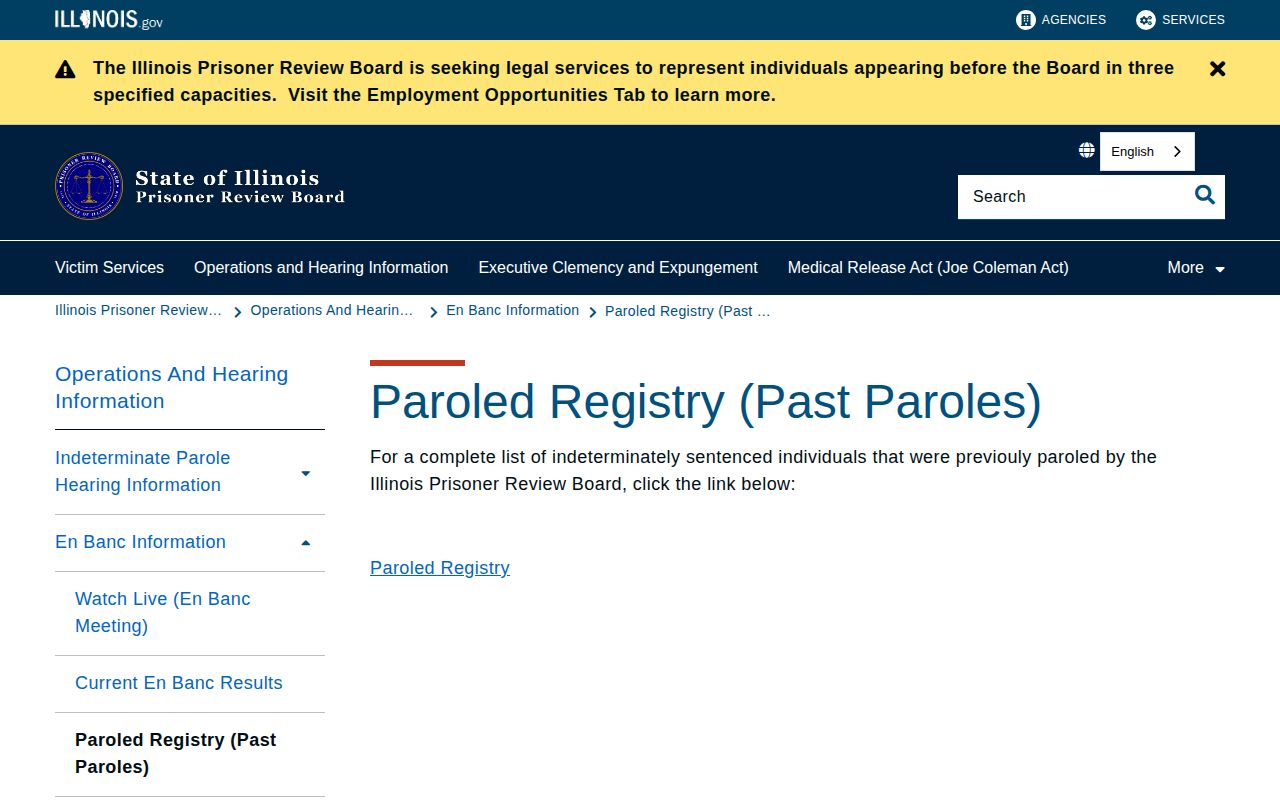
The image shows why PRB material should be used as a dated decision record, not as a complete statewide supervision search.
Kane Release Support Route
The Kane County Sheriff’s A Way Out program offers a round-the-clock substance-use assessment and referral route through participating police departments or a Treatment Coordinator Liaison from re-entry staff. The listed on-call number is 224-407-6758. Treatment transport may follow an assessment, but placement depends on availability and may be anywhere in Illinois.
Active warrants are reviewed and may be served. That means this is a navigation resource, not a promise of admission, transport, or continued community release. It also does not replace the supervising officer, court conditions, or a clinical provider. A person on Kane probation or Illinois parole should still follow the terms shown in the controlling supervision record.
Property After Kane Release
Property processing is separate from supervision status. The Kane jail FAQ says eligible property pickup runs from 7 a.m. to 9 p.m. after a call to Intake/Release. Written authorization from the detainee and photo identification for the recipient are required. The Detainee Services page says remaining account funds issue as a Prestige debit card on release or transfer.
That shared release-or-transfer treatment is important. Possession of property or a debit card does not prove return to the community, parole, probation, or final discharge. Use the Sheriff record for the custody destination and the court or IDOC record for supervision.
Do Kane Warrants End Release?
The Kane Circuit Clerk warrant page says warrant and body-attachment information is available through in-person review of the court file. There is no verified statewide public parole-absconder list that can rule out a warrant. Absence from a web result is therefore only an absence.
A motion to recall or quash carries no filing fee, but filing it does not deactivate the warrant. Only a judge’s signed order does. This distinction can change the outcome of expected release processing: a warrant may lead to continued holding or transfer even when another order supports release. Confirm the signed order, then confirm the physical custody result with Intake/Release or a Sheriff release record.
Match Kane Supervision Records
Good record matching starts with the full legal spelling, middle initial, date of birth when lawfully shown, and stable agency numbers. Use a Kane case number for the docket, a booking number for Sheriff custody, and an IDOC number for state supervision. Never merge two people merely because their names and county match. A parole district, sentence county, or arresting agency can help, but none is a unique identity key by itself.
Dates need the same care. A court judgment date, jail exit, actual Parole Date, VINE notice, and final discharge can describe different stages. Preserve each label and source. If the IDOC profile shows PAROLE, state that institutional release occurred and supervision continues. If a Kane order shows probation, state the court status without claiming an exact jail exit. This disciplined wording keeps the evidence useful.
Restricted or missing records also require restraint. A Kane docket can be sealed, expunged, juvenile, exact-spelling sensitive, or otherwise outside public access. A completed IDOC sentence can vanish from the live search by design. In either case, use the authorized court or archive route instead of converting silence into “no supervision.”
A direct probation sentence may never create an IDOC profile, and a transfer from the Kane jail to IDOC is not probation. For a suspected transfer, reconcile the Sheriff destination, receiving-system record, and signed court order. For final state discharge, combine the archived IDOC response with the sentencing blocks. For final county probation status, use the termination order. These source pairs show why one broad name search cannot settle every Kane supervision question.
When records conflict, keep each original date and wording. Ask the office that created the disputed entry to clarify it. The newest screen is not automatically the best historical record, and a planned event does not override a later custody action.