
Kane County 72-Hour Release Feed
The Kane County Sheriff detainee search includes an explicit “Released within the last 72 Hours” option. Unlike a current roster, this filter is designed around recent status changes at the Kane County Adult Justice Center. It is an all-person cohort, so it works well when the goal is to review releases across the past three days rather than locate one known historical booking.
The window rolls. A result can age out of the cohort without the underlying booking record being deleted. Kane's separate name and date fields may retrieve an older event. No official source states a universal retention period or exact refresh cadence, so describe 72 hours as the feed window only. The “information as of” value on a detail page is the display timestamp, not the actual exit time.
The official interface is visible through the Sheriff search source.
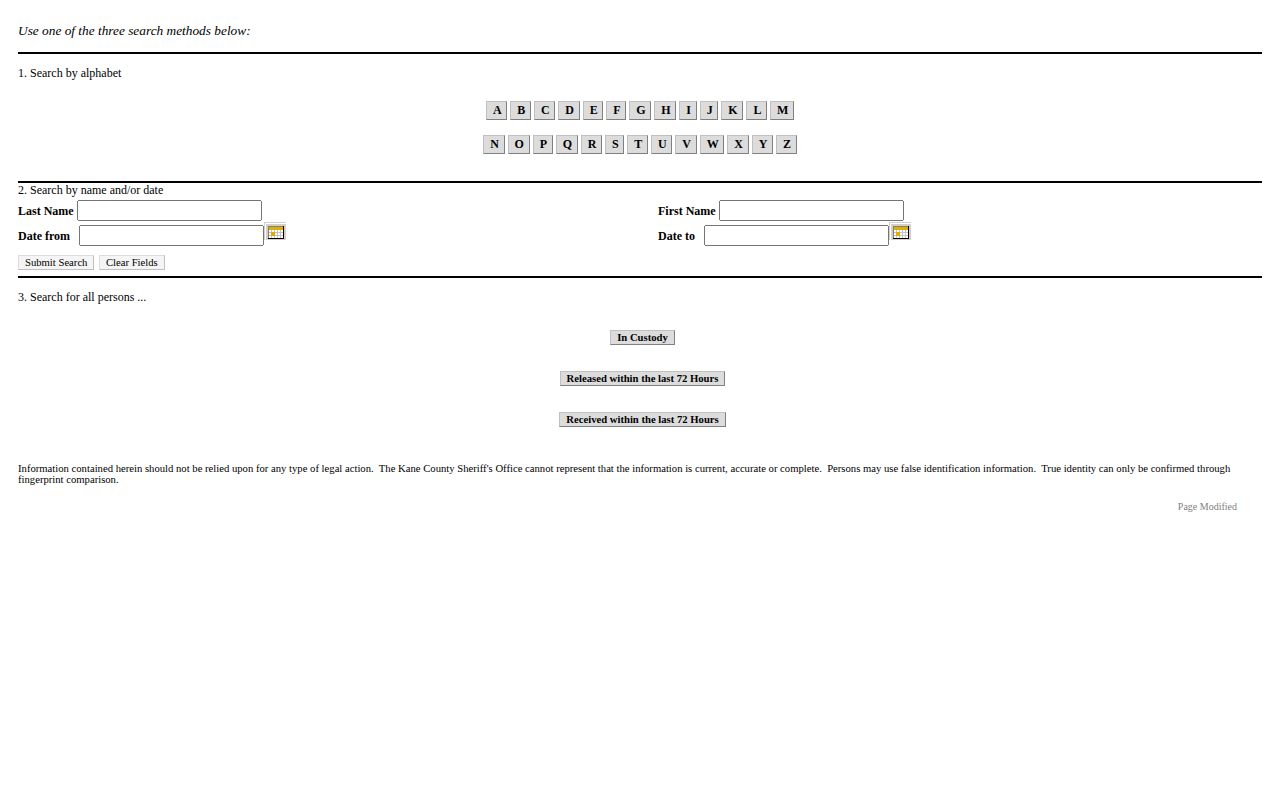
The screen confirms the released, received, and in-custody choices used to separate recent events.
Check Kane County 72-Hour Releases
Use the released filter first. Then open the detail rather than relying on the name shown in the cohort. Booking number, jail date, timestamp, and charge-level status help separate people with similar names and distinguish one stay from another.
- Open the Kane detainee search and select “Released within the last 72 Hours.”
- Choose the matching person and save the booking number and “information as of” timestamp.
- Read every charge row, custody status, and anticipated date in context.
- Compare the full case number or exact filed name in the Kane court portal.
- Call Intake/Release at 630-208-2083 when a recent court action has not appeared after the documented update window.
A booking photo may help distinguish two records, but it is not conclusive identity proof. Kane states that fingerprint comparison is conclusive. Use the booking number when calling or requesting a record, and avoid merging records based on name and county alone.
Kane County Release List Fields
The detail combines booking, charge, custody, and court information. Its fields do not all answer the same question. Prospective values must not be reported as completed events, and each charge can have its own status.
| Field | How to read it |
|---|---|
| Information as of | Time the displayed data was current. |
| Booking # | Best operational key for the specific jail stay. |
| Inmate # | Identifier that may help connect multiple stays. |
| Jail Date / Time | Start of the booking, not conviction or release. |
| Custody Status | Charge-level status that must be checked on all rows. |
| Anticipated Release Date | A planned date, not proof that release occurred. |
| Next Court Date / Location | Connection to the legal case, not an exit timestamp. |
Other displayed details can include arresting agency, days in custody, detainee location and type, charge, bail values, age, sex, and a booking image. Bail fields may be legacy or historical. They do not displace the signed court order under current Illinois pretrial procedure.
Weekend Kane County Releases
A three-day view is valuable around weekends and holidays because it spans more than a single calendar day. The Sixteenth Judicial Circuit provides for initial appearances on weekends and holidays. Yet a court decision and completed jail processing remain separate events. Warrants, holds, identity checks, paperwork, property, and transfer steps can affect timing.
The Sheriff publishes no fixed release hour. Its Adult Justice Center FAQ says processing may take several hours and court information can lag until papers arrive. It advises another check later that day and a call to Intake/Release after 6 p.m. when expected data is still missing. That instruction is a fallback, not a guaranteed refresh deadline.
Note: Preserve the court order date, web timestamp, and confirmed custody-end time separately instead of forcing them into one event time.
Kane Release or Agency Transfer
A person can leave Kane custody without entering the community. The Sheriff specifically identifies outstanding warrants, IDOC holds, and ICE holds as possible barriers to community release. Another county or warrant-holding agency may also receive the person. Such an event belongs in the recent-release view because Kane's custody changed, but it must be described as a transfer when the destination confirms continued detention.
| Result | Next confirmation |
|---|---|
| Community release | Sheriff detail or custody record showing the release type and destination. |
| IDOC transfer | IDOC Individual in Custody Search and the Kane receiving-agency field. |
| ICE transfer | Kane destination record, then the ICE current-custody locator. |
| Other warrant hold | Receiving agency record and relevant court order. |
| Still held on another charge | All charge rows and current Kane custody status. |
A court docket can explain the legal order or disposition. It does not independently establish where jail staff sent the person. For a suspected transfer, pair the Sheriff record with the receiving system and the signed court entry.
Kane Release Data Timing
Kane's local data has two useful traits: a true released-person cohort and a detailed record with a currency timestamp. Those features are stronger than inferring release from disappearance. They still have limits. Court data arrives with paperwork, the all-person window rolls, and no exact public update interval was found.
The FAQ screenshot comes from the official Sheriff source and documents the processing caveats.
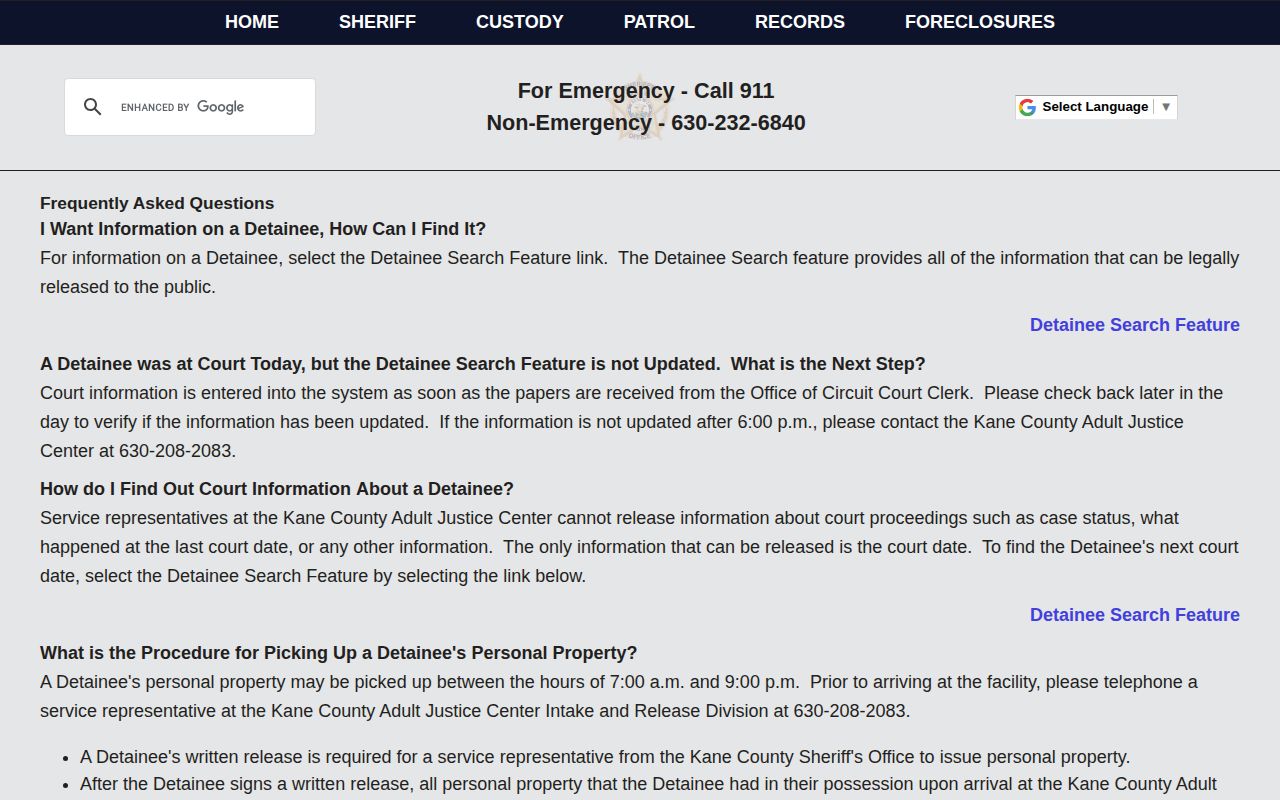
It supports checking the agency rather than guessing when a result and court event do not yet align.
Absence is only a lead. A person may be outside the rolling interval, listed under exact spelling not yet tried, restricted by law, transferred, still processing, or outside the county-jail system. Search the correct custody system before drawing a conclusion.
Older Kane County Release Records
After a result rolls out of the 72-hour cohort, search by full name and an appropriate date interval. Open any matching detail and retain the booking number. Next use the Kane Circuit Clerk instructions and Smart Search. Party spelling must match the filed name, while a full case number is the cleaner key when known.
The court docket may preserve pretrial orders, dispositions, sentences, custody credit, probation, and termination events. It cannot certify the jail's physical exit time. If the booking detail does not answer that question, use the Sheriff FOIA route. Ask for the releasable record that states actual date and time Kane custody ended, release type or code, and destination or receiving agency.
For a state-prison event, use IDOC. A PAROLE status with an actual Parole Date confirms institutional release to supervision, not final discharge. For a federal event, use BOP and the federal docket. Illinois VINE is an alert service rather than a durable historical record.
Kane Custody Status Comparison
Recent-release and current-custody views answer opposite questions. Selecting In Custody checks whether the person is presently held by Kane. Selecting Released within the last 72 Hours checks a recent Kane status change. Neither choice covers every correctional system.
- Still in Kane custody
- Use the Sheriff's In Custody view and read all charge statuses.
- Recently left Kane custody
- Use the official 72-hour released view and verify destination.
- Older Kane booking
- Use name/date search, court docket, and Sheriff records request.
- Illinois prison release
- Use IDOC status, actual Parole Date, and archived records for final discharge.
The Kane County 24-hour release check explains why the county's same-day path still begins with this three-day feed. The wider named-person search is covered on the home page through county, court, state, federal, and records-request channels.
Kane Release Evidence Levels
A careful recent-release check distinguishes a lead from confirmation. Absence from a view, a future anticipated date, or an uncorroborated alert may indicate where to check next. It cannot establish a release. A matching Sheriff released-filter entry is agency evidence that Kane custody changed as of the recorded timestamp, while the court docket can explain the legal basis.
Formal confirmation is a custody record or official response that states the actual date and time, release type, and destination. For an ordinary community release, pair the Sheriff event with the court order. For a transfer, add the receiving system. Preserve each source's date and context. When facts conflict, ask the originating agency to reconcile them rather than blending several dates into one.
Name matching also needs care. Record the full filed spelling, booking number, inmate number, and case number when available. The booking photo can support a match, but the Sheriff states that fingerprints are the conclusive method. Minimize personal details that are not needed to verify the custody event.